最後更新: 2024 年 8 月 13 日
Dennis
想了解更多內容與資訊, 歡迎聯絡.
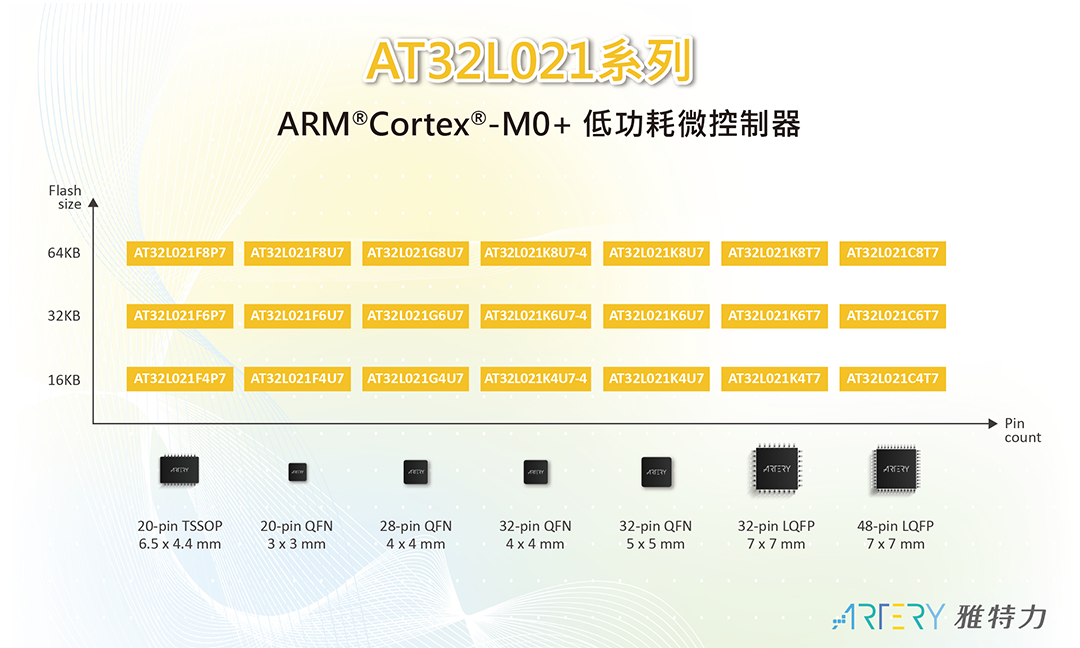
Artery Technology officially released the AT32L021, the first entry-level low-power MCU on February 28. It is equipped with Flash and SRAM of different capacities and provides 7 package types with a total of 21 model options. The minimum package area is only 3x3mm. In order to reduce energy consumption and extend equipment operation time, the AT32L021 series supports multiple energy consumption modes and sleep modes, provides short startup time and multiple wake-up sources, and is especially suitable for portable devices, wireless sensors, OBD, BMS, and RF industrial control. , wireless communication modules and Internet of Things equipment and other equipment that are powered by batteries and require small space development and design
Excellent power consumption efficiency and battery life
The AT32L021 series uses a 32-bit ARM® Cortex®-M0+ as the core, with a main frequency of 80MHz, supports up to 64KB Flash and 9KB SRAM, and provides a hardware divider (HWDIV) to improve computing performance. AT32L021 has the advantages of fast entry/wake-up low power mode and low standby power consumption. The current in deep sleep mode is about 9uA, the wake-up time is less than 17us, the current in standby mode is only 1.2uA, and it provides 5 WKUPs. The pin wakes up the standby mode to achieve the core advantages of low operation, low standby current and high-speed wake-up, effectively extending the battery life.
The key to MCU power consumption lies in the clock system. In the low-power mode corresponding to different device applications, it can switch between running and stopping hundreds of times per second, and provide the ability to quickly process tasks. The AT32L021 series supports multiple clock sources (CRM) , including HEXT, HICK, LEXT, PLL and LICK oscillator frequencies. Each clock source can be switched independently for flexible switching. When not in use, it can be shut down to reduce energy consumption. By dynamically managing the operating frequency of the system, it can meet application needs in different scenarios and reduce MCU power consumption.
Highly integrated peripherals reduce data latency
In order to reduce the processing time and power consumption of the core, a wealth of peripherals are integrated on the chip, such as a 12-bit high-speed ADC with a sampling rate of up to 2 Msps, a 16-bit advanced timer, five 16-bit general-purpose timers and a A 16-bit basic timer. In terms of communication, it has 2 I2C, 2 SPI/I2S, 4 USART, 1 CAN interface, and 1 infrared transmitter. All 4 USART interfaces can use DMA operation and can be configured as TX/RX pins for each other. Each channel has dedicated hardware DMA request logic, which can be triggered by hardware for continuous communication, effectively reducing data transmission delays; the CAN interface supports the 2.0B specification, has high reliability and good error detection capabilities, and is widely used in the automotive and industrial sectors.
Industrial-grade products enhance reliability
The AT32L021 series has up to 39 fast GPIOs, and the I/O ports support 5V tolerance, which can prevent 5V voltage surges from damaging the connection ports. It supports a wide industrial temperature range of -40~105℃, and provides a certified IEC-60730 safety test library to ensure safe operation of the equipment.
In order to strengthen the confidentiality and security protection of the product, AT32L021 is equipped with the sLib Security Library (Security Library) developed by Artli, which supports password protection of the designated code security library area, allowing solution providers to burn core algorithms into this area to make the program code It can only be executed but not read, providing downstream customers with secondary development convenience and enhancing the reliability of product development and use.
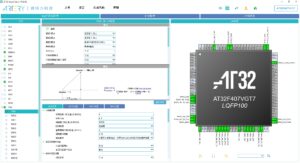
Artery provides users with a complete development ecological environment system and continues to improve various software and hardware development tool platforms. From the system development stage to mass production burning and subsequent firmware updates, it provides AT-START development boards and AT-Link Family programming and debugging. Hardware support such as tools, as well as software resources such as BSP standard library, ICP/ISP programming tools, AT32 IDE, AT32 Workbench graphical (GUI) development tools, etc. It also supports third-party development tool platforms such as Keil, IAR, Eclipse and RT-Thread. OS/UI platforms such as OS, FreeRTOS and LittlevGL provide developers with convenience, reduce repeated setting work, effectively shorten development and mass production time, and speed up product launch cycles.
At present, the AT32L021 series products have begun to send samples and will be officially put into mass production and supply in March 2024.